
Greek saffron brings agriculture, craftsmanship and cultural memory together. Explore the autumn harvest around Kozani, the role of its growers’ cooperative and the difference between ancient saffron imagery and the history of today’s regional production.
Purple fields, red threads: the Kozani harvest
In northern Greece, the autumn flowering of Crocus sativus turns saffron fields purple. The spice comes from the flower’s red stigmas, rather than its petals. Flowers must be collected and the delicate material handled with care before drying and sorting.
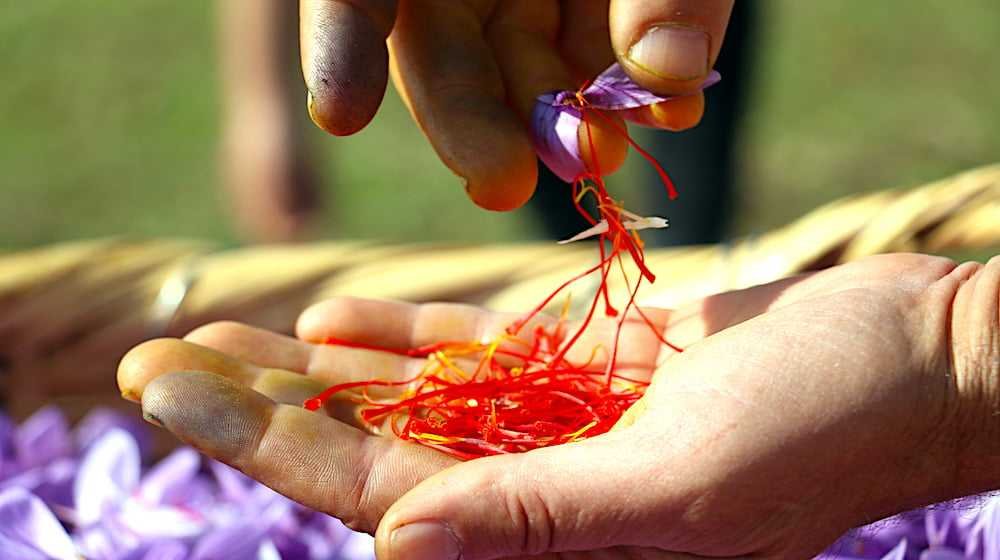
The European Commission describes a flowering period beginning in mid-October and lasting roughly 20–25 days. It highlights skilled drying as a particularly important step: poor handling can change the characteristics of the finished spice.
The growers’ cooperative
The Kozani Saffron Cooperative was established in 1971. According to its own account, it brings growers together to collect, process, package and distribute their saffron, while supporting cultivation knowledge and coordinated quality work.
This shared structure connects individual farms with the finished product. Harvesting is only the first stage; careful preparation, traceability and storage also matter to what eventually reaches a cook’s kitchen.
Ancient images and a living regional tradition
Saffron appears in ancient Aegean art and literature. The Commission’s account discusses Minoan-era harvesting imagery, including a saffron-gathering painting dated to around 1600 BCE. These images show saffron’s historical significance, but do not by themselves demonstrate uninterrupted cultivation in Kozani since the Bronze Age.
The history of modern Kozani cultivation is usually traced to the seventeenth century. The official Visit Greece account describes its reintroduction by Greek Macedonian traders returning from Austria.
The story of Krokos
In one Greek myth, Hermes accidentally kills the young Krokos while throwing a discus. Drops of blood become the flower’s red stigmas. This is a cultural explanation expressed through storytelling, rather than a botanical account of the plant’s origin.
What does Krokos Kozanis PDO mean?
Krokos Kozanis is a protected designation of origin (PDO). This identifies a product tied to a defined region and production specification. It helps distinguish that regional saffron from a generic origin claim; it does not mean that every saffron product sold in Greece automatically carries the designation.
When buying any saffron, look beyond evocative descriptions. A clear origin, identifiable supplier, appropriate packaging and relevant batch information are more useful than an unsupported “best in the world” promise.
Bringing saffron culture into the kitchen
Use saffron thoughtfully in rice, fish, chicken or a warm drink. Begin with a small amount and let its colour and aroma infuse into liquid before adding it to your dish. The aim is a balanced flavour, not a stronger result simply from using more threads.
Frequently asked questions
Is Greek saffron the same origin as Saffrona’s saffron?
No. This article explores Greece’s regional tradition. Saffrona’s catalogue presents Afghan saffron from Herat; reading about Kozani should not be mistaken for a claim that those products carry the Greek PDO.
Does an ancient fresco prove continuous cultivation in Kozani?
No. Ancient imagery and the documented history of a particular modern growing region are different kinds of evidence.
Sources & further reading
- European Commission: Krokos Kozanis PDO
- Kozani Saffron Cooperative: its history and role
- Visit Greece: harvesting the crocus