
1. Introduction: saffron cultivation under water and salinity stress
Saffron cultivation under water and salinity stress is an increasingly relevant research topic. In arid and semi-arid regions, saffron is an economically attractive crop, but water scarcity and increasing salinity in soil and irrigation water can threaten production.
Short-term experiments cannot fully explain the performance of a perennial crop. Studies spanning several growing seasons help growers understand both agronomic changes and their economic implications.
2. Scientific background
Responses to water and salinity stress involve interactions between soil conditions, available water and plant physiology. Tolerance of seasonal dryness should not be confused with resistance to salt accumulation in the root zone.
The study discussed here followed six growing seasons, allowing the effects of stress and planting methods to be examined over a longer production cycle.
3. Study design and methods
3.1 Experimental factors
The field investigation examined three main factors:
- irrigation-water salinity,
- irrigation levels of 100%, 75% and 50% of the crop water requirement,
- basin planting compared with in-furrow planting.
3.2 Measurements
The researchers assessed:
- saffron yield,
- corm yield,
- water productivity,
- economic indicators, including the benefit–cost ratio.
4. Yield development over time
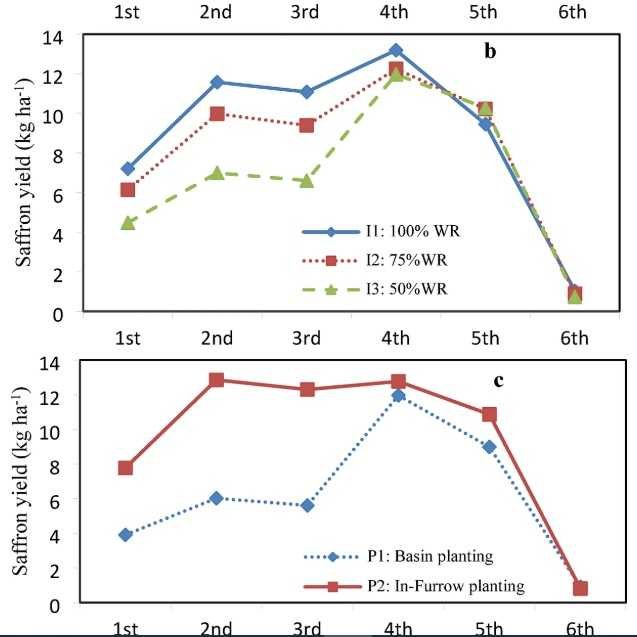
Yield did not follow a simple linear pattern. Production increased during the earlier seasons and declined later, with differences between planting methods.
The decline became more pronounced from the fifth growing season. By the sixth season, production was no longer economically feasible under the study’s assumptions. This is a result from the trial, rather than a universal deadline for every saffron field.
5. The effect of salinity
Higher salinity reduced yield. Salt accumulation in the soil is therefore an important consideration over a multi-year production cycle.
The study characterises saffron as highly sensitive to salinity. Growers should not assume that a crop adapted to dry conditions is also salt-resistant. Monitoring irrigation-water quality and the root-zone environment remains important.
6. Water management
In several seasons, the 75% irrigation treatment produced comparable or higher yields than full irrigation. The response depended on the treatment combination and growing season.
This does not establish 75% irrigation as a universal recommendation. It shows why water productivity and local crop requirements should be considered alongside yield when evaluating irrigation strategies.
7. Planting methods and efficiency
In-furrow planting performed better overall than basin planting in this experiment. Its production and water-use outcomes suggest that planting geometry can help moderate some effects of water and salinity stress.
Whether the same advantage occurs elsewhere depends on soil properties, irrigation practice and local climate.
8. Economic assessment
The trial’s agronomic and economic results indicate a limited period of profitable production under the conditions tested. Important factors include:
- salinity levels,
- appropriate irrigation management,
- a suitable planting method,
- the age and productivity of the established crop.
Profitability also depends on the prices and costs used in the analysis. The trial’s results should therefore support local planning rather than replace a site-specific business assessment.
9. Transferability and limitations
The findings come from a particular field experiment. Applying them to other regions requires consideration of local soil, climate, water quality and production costs. Nevertheless, the study provides useful evidence for evaluating saffron production in comparable dry environments.
10. Scientific reference
Khosravi, Z., Sepaskhah, A. R., and Talebnejad, R. Long-term optimization of saffron yield and economic water productivity as influenced by irrigation water depths, salinity levels, and planting techniques. Scientific Reports, 16, 2518 (2026). Published online 27 December 2025.
Explore further research on saffron cultivation under challenging environmental conditions in the Saffron Academy.