
Can saffron help with fatty liver disease?
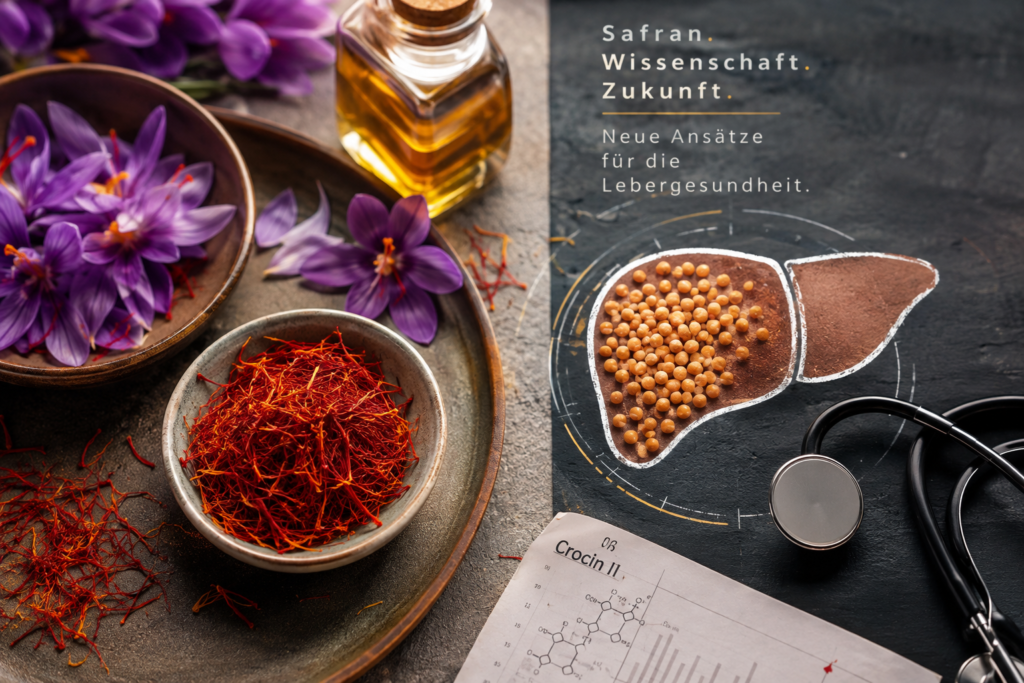
A preclinical study published in 2026 provides new evidence that crocin II, a naturally occurring bioactive constituent of saffron (Crocus sativus L.), may influence processes involved in metabolic fatty liver disease.
In cell experiments and mice with diet-induced metabolic fatty liver disease, crocin II reduced liver fat accumulation, affected lipid metabolism and lowered several markers of liver injury and inflammation.
The proposed mechanism is particularly interesting: according to the study, crocin II binds to the protein ANGPTL8 and promotes its degradation through the autophagy–lysosome pathway.
The scientific context is essential: the study did not involve people with fatty liver disease. It therefore does not prove that saffron or crocin II can treat fatty liver disease in humans. Instead, the findings provide a mechanistic basis for future clinical research. [Source 1]
What is fatty liver disease, and what does MASLD mean?
Fatty liver disease involves excessive fat accumulation in liver cells. A common form is now known as MASLD — metabolic dysfunction-associated steatotic liver disease.
MASLD is closely associated with metabolic risk factors such as:
- overweight and obesity,
- insulin resistance,
- type 2 diabetes,
- elevated blood lipid levels,
- high blood pressure.
The condition may persist for a long time without obvious symptoms. However, some people develop an inflammatory form with progressive liver damage and fibrosis.
Modern treatment therefore addresses more than the liver itself. Weight management, diet, physical activity and the treatment of associated metabolic conditions are also crucial. Regardless of new experimental compounds, these measures remain central to medical care for MASLD. [Source 2] [Source 3]
Why are researchers studying saffron in fatty liver disease?
Saffron contains numerous bioactive plant compounds. Well-known examples include crocin, crocetin, safranal and picrocrocin.
The authors of the new study took a systematic approach: they first screened a library of 70 natural saffron compounds to identify substances capable of interacting with a specific protein, ANGPTL8.
In this screening, crocin I and crocin II showed interesting binding to ANGPTL8.
Further biochemical investigations led the researchers to select crocin II as the stronger candidate.
This distinction matters: the study did not simply test “saffron for fatty liver”. It identified an individual saffron constituent and investigated its molecular mechanism.
What is crocin II, and why is it interesting for fatty liver research?
Crocin belongs to the characteristic carotenoids in saffron and contributes substantially to its intense colour.
Crocin II is a particular molecular form within this group of compounds.
In the study published in 2026, crocin II bound substantially more strongly to ANGPTL8 than crocin I. The dissociation constant measured using surface plasmon resonance was approximately 1.276 µmol/L for crocin II, compared with around 16.8 µmol/L for crocin I.
In this context, a lower dissociation constant indicates stronger binding affinity.
Additional molecular dynamics simulations indicated that the crocin II–ANGPTL8 complex remained structurally stable over the simulation period studied.
This is of research interest because the scientists went beyond observing a statistical effect: they identified a specific molecular candidate and a potential target mechanism.
What role does ANGPTL8 play in fatty liver disease?
ANGPTL8 stands for angiopoietin-like protein 8.
In humans, this protein is produced mainly in the liver and plays a role in regulating lipid metabolism. Research has linked ANGPTL8 to triglyceride metabolism, inflammatory processes and metabolic disorders.
ANGPTL8 is also of interest in MASLD research.
The study authors therefore consider the protein a potential therapeutic target. Earlier experimental approaches have, for example, sought to influence ANGPTL8 using antisense oligonucleotides or antibodies.
The new investigation takes a different approach: rather than simply blocking the production or activity of the protein, crocin II appears to promote its targeted degradation.
How might crocin II promote ANGPTL8 degradation?
This is arguably the most scientifically interesting finding of the study.
Using several independent methods, including CETSA, DARTS and SPR, the researchers first demonstrated that crocin II interacts with ANGPTL8.
They then observed a time- and dose-dependent decrease in ANGPTL8 protein levels after treatment with crocin II.
Further experiments suggested involvement of the autophagosome–lysosome pathway.
Autophagy is a natural cellular recycling process. Certain cell components or proteins are enclosed in specialised structures and subsequently broken down.
The authors propose the following mechanism:
Crocin II → binding to ANGPTL8 → promotion of autophagic degradation → less ANGPTL8 → changes in lipid metabolism
The possible involvement of the autophagy receptor p62/SQSTM1 is particularly interesting.
The researchers also discuss whether crocin II may share some functional similarities with PROTAC mechanisms, which use molecules to promote the targeted degradation of particular proteins.
However, this mechanism remains a subject of preclinical research.
What did crocin II show in liver cells?
In another part of the investigation, the researchers used primary liver cells from mice.
As expected, free fatty acids increased fat accumulation in these cells.
After treatment with crocin II, this fat accumulation decreased in a dose-dependent manner.
Intracellular triglyceride levels also declined.
At the molecular level, crocin II affected several genes involved in lipid metabolism:
- Fasn
- Dgat1
- Cidea
These genes are associated with lipogenesis, or fat production, and were downregulated by crocin II.
At the same time, expression of Atgl, a gene associated with lipolysis, or fat breakdown, increased.
A further experiment was especially important:
When ANGPTL8 was genetically absent, crocin II did not substantially reduce fat accumulation any further. Conversely, artificial overexpression of ANGPTL8 weakened the effect of crocin II.
This supports the hypothesis that ANGPTL8 is a central molecular target of crocin II.
What did crocin II show in mice with fatty liver disease?
For the animal experiment, mice received a high-fat diet for ten weeks to establish a model of MASLD.
The animals received crocin II at three doses:
- 5 mg/kg,
- 10 mg/kg,
- 20 mg/kg body weight.
A key limitation for translation to humans is that crocin II was injected intraperitoneally into the mice. It was not eaten as saffron spice or taken orally as an ordinary dietary supplement.
The researchers observed several changes under crocin II treatment.
In a dose-dependent manner, the mice showed:
- less fat accumulation in the liver,
- improved glucose tolerance,
- improved insulin resistance,
- lower serum triglycerides,
- lower total cholesterol,
- lower LDL cholesterol,
- a more favourable LDL-C/HDL-C ratio.
At the highest crocin II dose, the body weight of high-fat-fed animals was also 18.58% lower than in the corresponding control group.
This figure comes from an animal model and must not be interpreted as an expected weight loss in humans.
How strongly did crocin II affect liver fat and liver markers?
The investigation also provided quantitative data on fat levels within the liver.
At the highest dose tested in the mouse model, crocin II reduced:
- hepatic triglycerides by approximately 48%,
- hepatic total cholesterol by approximately 52%,
compared with the corresponding high-fat-diet controls.
The liver enzymes ALT and AST, which were elevated in the high-fat-diet model, also decreased under crocin II treatment.
Histological examination supported these findings: liver tissue from the crocin II-treated groups showed substantially fewer fat deposits.
Oil Red O staining likewise indicated reduced hepatic lipid accumulation.
These results suggest a marked effect on steatosis in the animal model, but do not establish whether the same effects occur in humans.
Can crocin II influence inflammation in fatty liver disease?
MASLD is more than a disorder of fat accumulation. Inflammation plays an important role, particularly in progression towards MASH and fibrosis.
The researchers therefore also examined macrophages in liver tissue.
The livers of crocin II-treated mice contained fewer F4/80-positive macrophages.
This suggests that the intervention was also associated with reduced inflammatory cell infiltration in the animal model used.
Whether crocin II has corresponding anti-inflammatory effects in people with MASLD was not tested in this study.
Does crocin II alter the broader lipid metabolism of the liver?
A particularly extensive part of the study involved a lipidomics analysis.
The scientists examined the pattern of many different liver lipids, rather than only individual cholesterol or triglyceride measurements.
They identified 134 lipid species whose concentrations changed under crocin II treatment.
These included:
- triglycerides (TG),
- diglycerides (DG),
- cholesteryl esters (ChE),
- various phosphatidylcholines (PC),
- phosphatidylethanolamines (PE).
A larger number of TG and DG species decreased under crocin II treatment.
The ratios of certain phospholipids also changed, particularly the PC/PE ratio.
The authors interpret these changes as further evidence that, in the animal model, crocin II affects hepatic lipid metabolism more broadly than individual blood measurements alone.
Has this saffron-related treatment been studied in people with fatty liver disease?
For the study discussed here, the answer is clear:
No.
The investigation consisted of:
- molecular analyses,
- cell experiments,
- experiments with primary mouse hepatocytes,
- a mouse model of diet-induced MASLD.
No people with fatty liver disease were treated.
The study also did not investigate whether consuming saffron threads or a commercially available saffron preparation produces comparable crocin II concentrations in humans.
This distinction is crucial.
Can we conclude from this study that saffron treats fatty liver disease?
No.
The findings show that, under experimental conditions, crocin II has an interesting molecular mechanism and improved relevant MASLD parameters in cell and mouse models.
However, they do not establish that:
- saffron threads treat fatty liver disease,
- saffron preparations cure MASLD,
- crocin II has the same effects in humans,
- the doses used in the mouse model can be transferred to humans.
The scientifically appropriate conclusion is therefore:
Crocin II is a promising preclinical research candidate for MASLD. Its potential efficacy and safety in humans must first be investigated in clinical trials.
What did the study not investigate?
A realistic assessment must also consider what the study cannot answer.
It did not investigate:
- patients with diagnosed MASLD,
- treatment with ordinary saffron threads,
- oral crocin II doses in humans,
- the optimal dose for humans,
- long-term adverse effects in MASLD patients,
- interactions with medicines,
- possible reversal of advanced fibrosis,
- clinical outcomes such as cirrhosis or liver cancer.
Whether the described ANGPTL8 mechanism translates from the mouse model to humans also remains to be confirmed.
What does this research mean for people with fatty liver disease?
For people with diagnosed fatty liver disease, these results are scientifically interesting but do not currently change standard medical care.
Guidelines continue to emphasise lifestyle changes, including:
- appropriate weight reduction,
- regular physical activity,
- a balanced diet,
- management of diabetes and blood lipids,
- reducing or avoiding alcohol according to the individual medical situation.
People at higher risk or with advanced liver disease may need further diagnostic investigations and medical treatment. [Source 2] [Source 3]
This animal study therefore does not justify using saffron or crocin II as self-treatment for fatty liver disease.
The value of the research lies in identifying a potential biological mechanism that could be investigated therapeutically in the future.
What questions does further research need to answer?
The study raises several important research questions:
Does crocin II also work in people with MASLD?
This cannot yet be answered.
What oral dose would be required in humans?
This is unknown.
Does orally consumed crocin II reach sufficiently high concentrations in the liver?
This requires pharmacokinetic investigation.
Would the effect persist with long-term use?
This study provides no data on that question.
Can crocin II influence fibrosis or MASH?
This question also remains open.
Is ANGPTL8 also the decisive mechanism in humans?
The experimental data support investigating this possibility, but clinical confirmation is lacking.
What is the scientific conclusion?
The study published in 2026 provides an unusually detailed mechanistic insight into the possible relationship between a saffron constituent and metabolic fatty liver disease.
In the experiments, crocin II bound to ANGPTL8 and promoted its degradation through the autophagy–lysosome pathway. In cell models, it reduced fat accumulation and affected genes involved in lipid metabolism.
In mice with diet-induced MASLD, researchers observed less liver fat, lower hepatic triglyceride and cholesterol levels, more favourable blood lipid values, improved insulin sensitivity and fewer signs of inflammation under crocin II treatment.
These findings make crocin II an interesting preclinical candidate for further MASLD research.
They do not prove that saffron treats fatty liver disease in humans.
The crucial next step would be controlled human studies investigating the dose, bioavailability, efficacy and safety of crocin II in people with MASLD.
Until such data are available, saffron-related fatty liver research remains a promising research question rather than an established treatment.