
Saffron micropropagation explores how small pieces of plant material can develop into new plantlets under controlled laboratory conditions. A 2025 BMC Plant Biology study examined combinations of NAA, BAP and salicylic acid to improve different stages of that process.
Laboratory tissue culture · Several growth-regulator combinations · Different outcomes for callus, shoots, roots and microcorms · Commercial performance still requires validation.
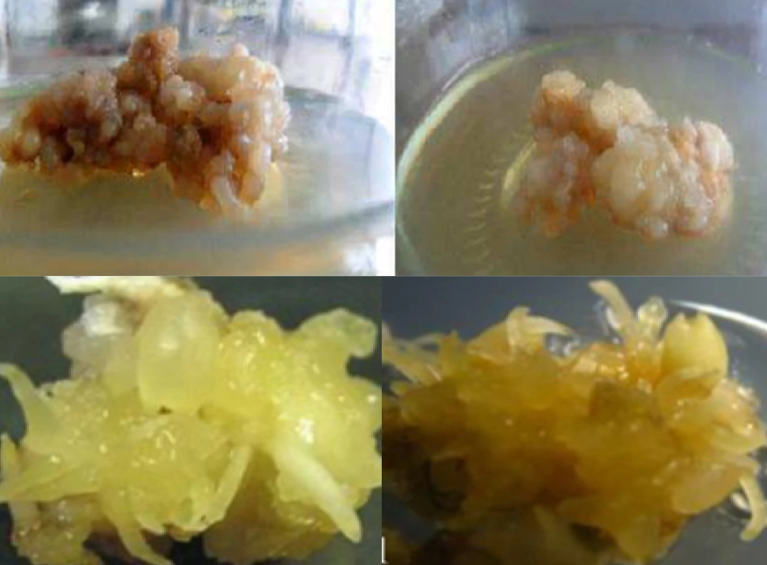
The study’s main ingredients and outcomes
NAA is an auxin-type growth regulator, BAP a cytokinin, and salicylic acid an elicitor investigated alongside them. The study measured callus induction, shoot regeneration, rooting and microcorm development.
What the researchers reported
- Callus induction reached 46.53% with 0.5 mg/L NAA, 1 mg/L BAP and 15 mg/L salicylic acid.
- The abstract reports peak shoot regeneration of 34.90% and rooting of 15.46% with a 1 mg/L NAA and 1 mg/L BAP combination.
- Microcorm development responded to 0.5 mg/L NAA and 2 mg/L BAP across the tested salicylic-acid concentrations.
- Salicylic acid reduced tissue browning in several treatments.
The full results describe some treatment details differently from the abstract, including the shoot-regeneration combination. Readers designing experiments should consult the figures and methods rather than treating this summary as a ready-to-use protocol.
Why the outcome matters
A large amount of callus is not the same outcome as a healthy rooted plantlet. Likewise, the number of microcorms, their diameter and the percentage of material forming them are separate measures.
Calling one treatment best without naming its outcome can therefore be misleading. A useful propagation process needs to connect all stages, including successful development after leaving laboratory conditions.
Questions for practical propagation
- Reproducibility: Does the response persist with different starting material and in another laboratory?
- Plant quality: Are regenerated plants healthy and stable after acclimatisation?
- Crop performance: Do plants flower and produce a suitable saffron harvest?
- Economics: What labour, equipment, energy and losses does the full process require?
- Quality control: How are contamination and variation monitored?
Controlled conditions can help researchers investigate propagation. They do not automatically guarantee disease-free plants, genetic stability or a lower environmental footprint.
Frequently asked questions
Is micropropagation the same as cell-based saffron ingredients?
No. Micropropagation aims to generate plant material for further growth. Producing selected compounds in cell cultures is a different goal.
Can these concentrations be applied directly to a field?
No. They describe experimental culture media and should not be interpreted as agricultural application instructions.
Primary source
Ahmed, Z. S. et al. (2025). Optimizing micropropagation and microcorm induction in saffron (Crocus sativus L.) using PGRs (NAA and BAP) and elicitor salicylic acid. BMC Plant Biology, 25, 877. Read the open-access paper.
Explore cultivation and biotechnology in the Saffron Academy, or discover Saffrona’s culinary saffron.