
Saffron Academy · The essential guide
What Is Saffron?
An evidence-aware introduction to saffron’s botany, quality, compounds, origin, flavour and cultural significance.
Saffron at a glance
Saffron is the spice obtained from the dried red stigmas of Crocus sativus L. Each flower produces only three stigmas. Careful harvesting, separation and drying transform them into the threads whose golden colour, distinctive aroma and gentle bitterness are associated mainly with crocins, picrocrocin and safranal.
- Plant part
- The three red stigmas of each flower.
- Approximate yield
- About 150–200 flowers for one gram of dried saffron; the figure varies with growing and processing conditions.
- Harvest
- Careful hand work during a short flowering period.
- Key compounds
- Crocins, picrocrocin and safranal, alongside many other constituents.
- Quality framework
- The ISO 3632 series for dried saffron.
Saffron is a plant, an agricultural product, a food, a natural colouring and flavouring material, a subject of chemical research and a cultural heritage. Understanding it therefore means connecting botany, farming, chemistry, quality analysis, history, cooking and culture.
The saffron plant: Crocus sativus L.
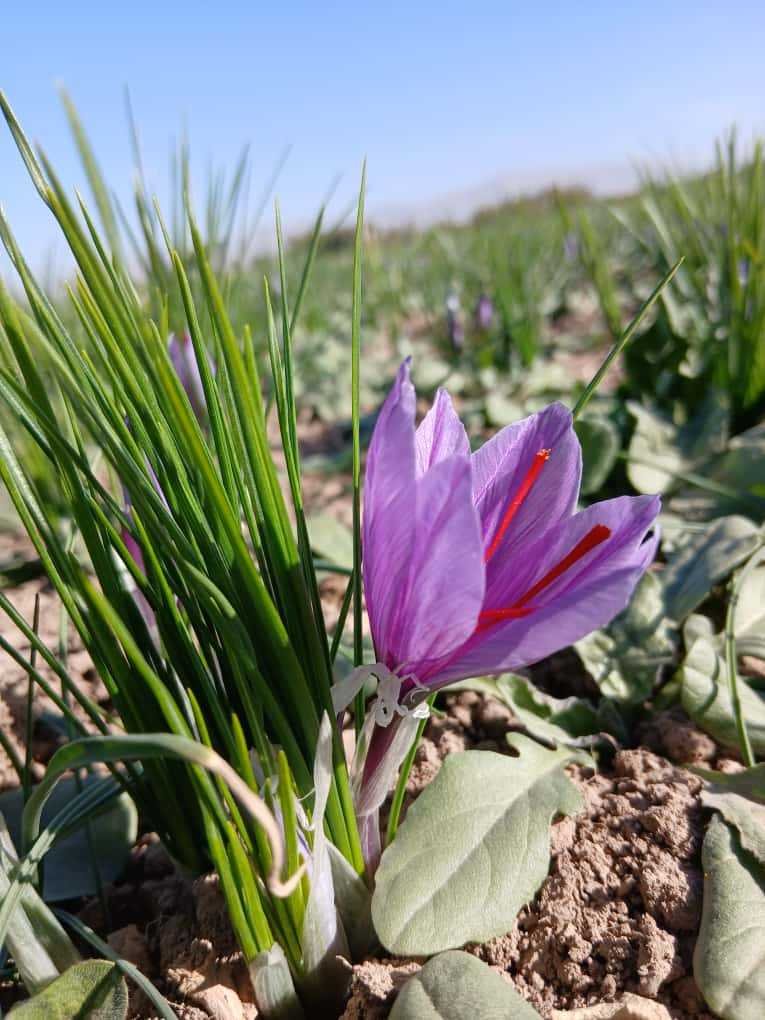
Saffron comes from Crocus sativus L., a member of the iris family, Iridaceae. The cultivated plant is sterile and does not produce viable seeds. It is propagated vegetatively through daughter corms. Its violet flowers appear in autumn, with three red stigmas and three yellow stamens. Only the stigmas form the spice after separation and drying.
| Scientific name | Crocus sativus L. |
|---|---|
| Family | Iridaceae |
| Life form | Perennial, corm-forming geophyte |
| Chromosomes | Triploid: 2n = 3x = 24 |
| Seed formation | No viable seeds in the cultivated sterile plant |
| Propagation | Daughter corms developing from the mother corm |
| Flowering | Autumn; timing depends on region, climate and cultivation |
| Flower | Violet perianth, three yellow stamens and three red stigmas |
| Harvested part | The three red stigmas, separated and dried |
“Saffron bulb” is a common informal expression. Botanically, the storage organ is a corm: a swollen stem structure.
From flower to saffron thread
Picking a flower is only the beginning. Harvesting, separation, sorting, drying and protected storage turn fresh stigmas into a stable spice. Drying is particularly important for the development and preservation of colour, bitterness and aroma.
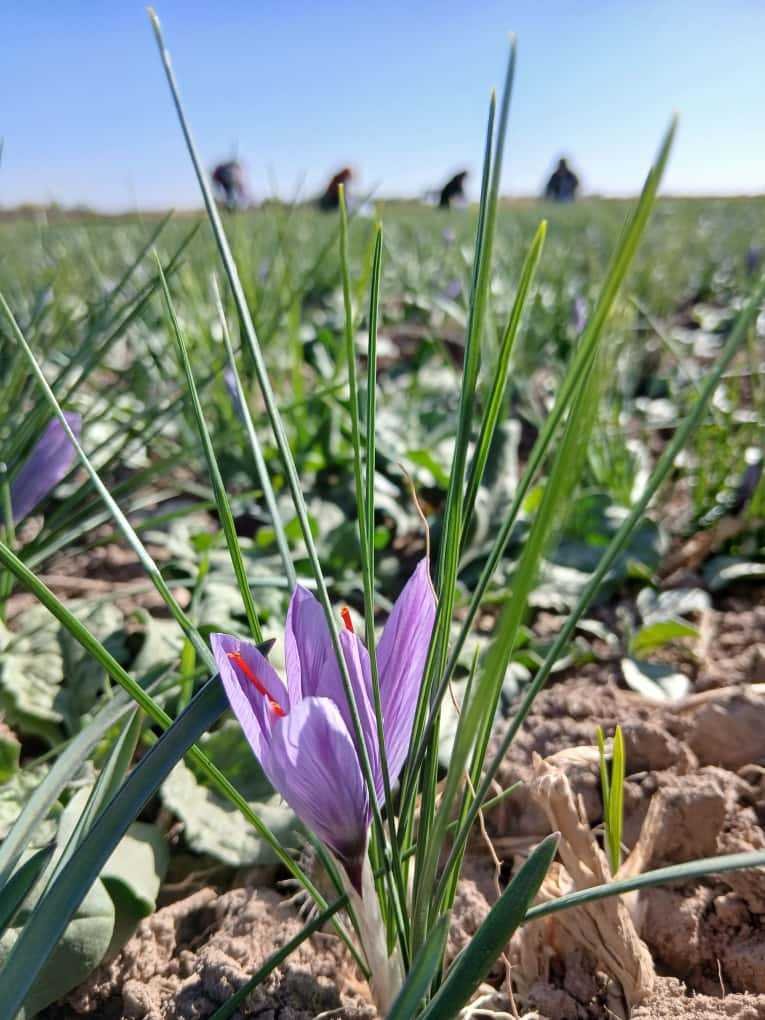
- Gather flowers by hand. Newly opened flowers are collected during the short flowering period. Gentle handling reduces pressure damage and exposure to excess moisture.
- Separate the red stigmas. The three stigmas are manually separated from petals, yellow stamens and other flower parts. Clean separation is essential.
- Sort and inspect. Visible plant remnants, damaged pieces and foreign material are removed before drying. Consistent sorting supports a more even drying result.
- Dry under controlled conditions. Drying reduces water, supports storage and develops the characteristic aromatic profile. Temperature, duration and method influence composition.
- Cool and stabilise. The dried threads should cool in clean, dry conditions. Packaging too early can encourage condensation.
- Protect during storage. Use well-sealed, food-suitable containers and protect saffron from light, heat and moisture. Oxygen and adverse storage conditions can accelerate deterioration.
Fresh stigmas are not yet a shelf-stable spice. Drying changes the balance of its characteristic constituents: crocins mainly contribute colouring power, picrocrocin contributes bitterness and safranal is central to aroma.
ISO 3632 concerns the processed, dried product in whole-thread, cut-thread and powder forms, rather than the fresh flower.
How is saffron quality measured?
“Premium”, “top quality” and “best origin” are marketing descriptions unless supported by verifiable criteria. ISO 3632 provides a shared framework for specifying and testing dried saffron using analytical, physical and visual criteria.
Part 1 · Specification
ISO 3632-1:2025 specifies requirements for whole threads, cut threads and powder. The third edition was published in July 2025 and includes storage and transport recommendations.
Part 2 · Test methods
ISO 3632-2:2010 describes standardised test methods for dried saffron. It is distinct from the specification part of the series.
Three UV/Vis measurement wavelengths
A spectrophotometer measures light absorption by a standardised saffron extract. Analytical indicators are calculated from those measurements. The measurement wavelength and the resulting quality value are different quantities.
| Wavelength | Associated indicator | Interpretation |
|---|---|---|
| 257 nm | Bitterness or flavour strength | Conventionally associated with picrocrocin-related bitterness; not a selective picrocrocin assay. |
| 330 nm | Aromatic strength | Conventionally associated with safranal-related properties; not a specific safranal measurement. |
| 440 nm | Colouring strength | Associated mainly with crocins; 440 nm is the wavelength, not the calculated colouring value. |
For example, 440 nm identifies where the instrument measures. A value such as 190, 200 or 240 describes a calculated colouring-strength indicator. They must not be treated as the same measurement.
What else is assessed?
- Moisture and volatile matter: relevant to weight, stability and storage.
- Foreign plant material: unwanted flower parts or other botanical material.
- Mineral residues: ash values can indicate mineral contamination or processing problems.
- External foreign matter: materials that do not naturally belong to saffron.
- Product form: whole threads, cut threads or powder.
- Visual and sensory characteristics: appearance and smell complement instrumental analysis.
A standardised result offers a more objective assessment than packaging or origin claims. It refers to the tested sample and analysis date. UV/Vis indicators are not exact single-compound measurements because other compounds may contribute to absorption. Targeted compound analysis, origin questions or complex suspected fraud may require HPLC, mass spectrometry, NMR or chemometric methods.
Further reading: Tsimidou and colleagues on analytical interpretation and our saffron quality guide.
Which compounds give saffron its character?
Saffron’s character comes from a complex mixture rather than a single substance. Specialised plant compounds called apocarotenoids are especially important. Crocins, picrocrocin and safranal contribute to colour, bitterness and aroma, alongside numerous volatile and non-volatile constituents.
Crocins · Colour
Crocins are glycosylated esters of crocetin. Attached sugar groups increase their water solubility, which is unusual compared with many other carotenoids. A small quantity of saffron can therefore colour water, rice, sauces or dough golden yellow. Read the scientific background on crocins.
Picrocrocin · Bitterness
Picrocrocin is a non-volatile, bitter compound already present in fresh stigma tissue. It contributes substantially to saffron’s characteristic taste. During processing and storage, picrocrocin and its breakdown products can give rise to aromatic compounds. Study of picrocrocin biosynthesis.
Safranal · Aroma
Safranal is an important volatile compound in dried saffron. Drying, processing and storage affect its amount and its relationship to other aroma compounds. More safranal does not automatically mean better overall quality. Scientific review of safranal.
Crocin and crocetin are different
Crocetin is the carotenoid framework to which sugar groups are attached in crocins. “Crocins” describes a group of glycosylated crocetin esters, not just one chemical substance.
In a simplified biosynthetic account, zeaxanthin undergoes enzyme-mediated oxidative cleavage to form precursors. Further enzymatic and processing steps give rise to characteristic colour, bitter and aroma components.
| Compound | Class or property | Role |
|---|---|---|
| Crocins | Glycosylated apocarotenoids; relatively water-soluble | Golden-yellow colouring strength |
| Crocetin | Apocarotenoid and carboxylic acid; unglycosylated framework | Chemical basis of different crocin compounds |
| Picrocrocin | Non-volatile, bitter apocarotenoid glycoside | Bitterness and an aroma precursor |
| Safranal | Volatile aromatic monoterpene aldehyde | An important part of saffron’s scent |
These markers do not explain saffron completely. Its sensory profile depends on interactions, concentrations, processing and storage. A high result for one marker is not automatically the highest overall quality.
Why is saffron so expensive?
The cost reflects a small usable yield, a short harvest window, precise manual work, processing losses and requirements for sorting, drying, storage, testing and trade. No single factor explains the final price.
Production figures are approximate
Published literature often cites about 150,000–200,000 flowers for one kilogram of dried saffron and up to roughly 400 hours of work per kilogram. Another study describes approximately 78 kg of fresh flowers for one kilogram of dry product. These figures vary with flower size, yield, location and production system; they are not universal constants.
One study of traditional systems describes about 1,200 labour hours per hectare per year, with roughly 865 hours spent on flower harvest and stigma separation. Experience, organisation, farm size and mechanisation influence the actual workload.
The chain of costs
- Only three stigmas per flower: most flower material does not become the spice.
- Very low individual weight: many flowers produce a small quantity of dried product.
- A short harvest period: work must be concentrated into a limited season.
- Delicate manual separation: careful handling protects the stigmas.
- Sorting and cleaning: removing damaged pieces and foreign matter takes time.
- Drying losses: removing water substantially reduces weight.
- Quality risk: poor drying, moisture, light or heat can reduce value.
- Testing, packaging and distribution: traceability, transport and trade add costs.
| Cultivation | Corms, soil work, irrigation, care, land and yield risk |
|---|---|
| Harvest | Seasonal workers, daily collection and transport |
| Stigma separation | Manual precision work and clean sorting |
| Drying | Energy, equipment, time control and hygiene |
| Quality control | Inspection, laboratory analysis, traceability and documentation |
| Packaging | Food-suitable protection against light, air and moisture |
| Import and distribution | Transport, insurance, customs, storage, taxes and sales |
Production demands explain why real saffron cannot be arbitrarily cheap. The reverse conclusion is false: a high selling price does not prove authenticity or quality. Unusually low prices deserve scrutiny, but a specific product must be assessed on its evidence.
Sources: Mzabri et al., Criado-Navarro et al. and Giorgi et al.
How does saffron taste, smell and colour food?
Saffron combines golden colouring power, a fine bitterness and a complex aroma. Crocins, picrocrocin and safranal provide chemical reference points, but sensory perception also depends on other compounds, origin, drying, storage, quantity and preparation.
Colour · Golden yellow to yellow-orange
Crocins dissolve relatively well in water. The released colour is typically yellow or golden yellow, rather than the strong red of the dry threads. Amount, particle size, liquid, temperature and contact time affect how quickly and intensely the colour develops.
Aroma · Complex and volatile
Safranal is important, but the complete scent comes from multiple volatile compounds. Descriptions may include floral, herbal, honey-like, spicy, hay-like and gently woody notes. Sensory terms express perceptions rather than fixed chemical measurements.
Taste · Gently bitter, not sweet
Picrocrocin is a central contributor to bitterness. Other constituents, including certain flavonoids, may also contribute bitter or slightly astringent impressions. A sweet-smelling aroma should not be confused with a sweet taste.
Observe saffron in water
- Place a few threads on a clean, pale surface and examine their form, colour and visible foreign material.
- Add a small amount of clean, warm water; boiling water is unnecessary for observation.
- Watch the liquid gradually develop a golden colour. The threads should not immediately dissolve completely.
- Smell the infusion and, if the product is suitable as food, carefully taste a small amount.
This exercise shows the release of colour and aroma. It does not certify authenticity, geographic origin or an ISO category.
| Property | Main chemical association | Important factors |
|---|---|---|
| Colour | Crocins | Concentration, solubility, age, light, temperature and storage |
| Bitterness | Picrocrocin and other contributors | Amount, origin, processing, extraction and individual perception |
| Aroma | Safranal and other volatile compounds | Drying, ageing, packaging, oxygen, heat and moisture |
| Overall impression | Interactions between volatile and non-volatile compounds | Product quality, food matrix, quantity and preparation |
Other colourants can produce an intense colour. A strong smell can reflect processing, ageing or added aroma. Sensory observations are useful, but disputed or professional quality questions require suitable standardised analysis.
Scientific background: saffron aroma research, picrocrocin, flavonoids and sensory properties, and chemical and sensory assessment.
How do you use saffron in the kitchen?
Saffron is used in small quantities. The goal is to distribute colour, bitterness and aroma throughout the dish. Product form, pretreatment, liquid, temperature, contact time and timing all influence the result.
Threads, powder or infusion?
Whole threads show the natural stigma form and release colour and taste gradually. They can be gently broken or soaked before use.
Ground saffron disperses quickly, but the original plant form is difficult to assess. Choose a traceable source and protect the powder from light, air and moisture.
A saffron infusion transfers colour and other compounds into a small amount of liquid before cooking. Add the whole infusion, including the saffron material, to the dish.
A reliable four-step starting point
- Measure the amount. Remove only what the recipe requires and close the remaining saffron.
- Break the threads gently. Fingers or a small mortar can increase the available surface without necessarily reducing everything to powder.
- Infuse in a little liquid. Water, stock or a suitable liquid from the recipe can be used.
- Add the complete infusion. Include both the liquid and remaining threads for more even distribution.
Crocins’ sugar groups support water solubility, and picrocrocin can also transfer into aqueous extracts. Temperature, time and the liquid’s composition affect extraction. No single scientifically perfect temperature or steeping time applies to every dish.
A small preliminary infusion can improve distribution. Longer or more aggressive heating is not automatically better. See the saffron preparation guide for practical detail.
When should you add saffron?
- Early: longer contact can support even colouring.
- During cooking: helps integrate colour, bitterness and aroma without exposing saffron to the entire cooking time.
- A small later addition: can support a fresher aromatic impression in some dishes, while the main portion still needs sufficient distribution.
| Application | Suggested starting method | Consideration |
|---|---|---|
| Rice and grains | Mix an infusion into part of the cooking liquid | A pale food makes golden colour visible |
| Soups and sauces | Incorporate an infusion during cooking | Liquid helps extraction and distribution |
| Dairy and desserts | Disperse finely broken saffron in a small liquid portion | Sweetness can balance natural bitterness |
| Bread, cakes and pastry | Distribute an infusion or fine powder in the liquid ingredients | Uneven mixing can create local colour and flavour differences |
| Drinks | Prepare a small infusion, then dilute | Colour, bitterness and aroma are directly apparent |
| Savoury stews | Add during cooking, with a small later portion if appropriate | Strong seasoning can overpower delicate saffron aroma |
Why there is no universal amount
The suitable quantity depends on quality, colouring strength, product form, liquid volume, portions and desired intensity. Start with a modest recipe-specific amount, distribute it fully and assess the result. Too much can allow bitterness to dominate.
For repeatable results, weigh the saffron and record the portion count, liquid volume and preparation method.
Common mistakes
- Using large quantities in the belief that more is always better.
- Sprinkling threads only as decoration without enough liquid contact.
- Covering saffron’s aroma with excessive strong spices.
- Opening the entire container above a steaming pan.
- Judging the result only by colour.
- Leaving saffron open to light, air, heat or kitchen moisture.
Explore our recipe collection. Scientific background: extraction conditions, crocins in food, and colour, taste and aroma applications.
Where does saffron come from and where is it grown?
Distinguish the plant’s evolutionary origin, its historical domestication and the production country of a particular product. A plant can originate in one region, spread over centuries and now be cultivated in many countries.
Botanical origin
Crocus sativus is a sterile cultivated form. Kew Science identifies it as a cultigen from Greece. Genetic and cultural-historical research connects its ancestry with Crocus cartwrightianus in the Greek-Aegean region. Details of domestication continue to be investigated.
In a simplified account, people propagated selected plants vegetatively. Corms, growing knowledge and usage traditions then spread through trade and cultural contact.
Product provenance
The origin of a particular saffron product identifies where its flowers were grown, harvested and processed. It describes the production chain and does not automatically establish quality.
Producing regions and traditions
- Iran: a major global producer, with important dry growing regions in the northeast. Gonabad’s qanat-based saffron system is recognised within FAO’s agricultural heritage programme.
- Afghanistan: especially associated with Herat, its dry climate, growing knowledge and labour-intensive family production. Its production scale is smaller than Iran’s.
- India and Kashmir: traditional growing is strongly associated with Jammu and Kashmir, including Pampore. Its regional cultural and economic significance is substantial.
- Greece, Spain and Italy: regional traditions include Kozani, La Mancha, Sardinia and Abruzzo. Some production regions use protected geographical designations.
- Morocco: Taliouine and the Anti-Atlas are important, with small farms and cooperatives. Aït Souab–Aït Mansour is represented in FAO’s agricultural heritage network.
- Other countries: cultivation also occurs in Azerbaijan, China, Türkiye, Pakistan and smaller European and North American projects. A new growing area does not automatically achieve stable yields or consistent quality.
In a 25 November 2025 statement, FAO described Iran as producing approximately 85–90% of the world’s saffron. This is an institutional estimate, not a constant share for every harvest year.
What conditions does the crop need?
- A seasonal rhythm: autumn flowering, leaf growth, corm development and dormancy follow an annual cycle.
- Summer conditions: warm, dry summers can support dormancy; persistent waterlogging is unfavourable.
- Cool-season growth: leaves develop during cooler months. Suitable sites can support cultivation in regions with cold winters.
- Drainage: permeable soil reduces waterlogging and corm-rot risk.
- Water supply: irrigation needs depend on climate and growth stage. Low water demand does not mean no water.
- Planting material: corm health, size and physiological condition influence growth and flowering.
- Management: depth, density, weeds, nutrition, disease management and harvest organisation affect yield.
Does saffron have a terroir?
Climate, soil, altitude, plant material, irrigation and local knowledge can influence the product. Drying, storage, cleanliness and age may strengthen, weaken or outweigh those regional differences.
“Terroir” should therefore describe interacting conditions and practices, rather than a blanket quality promise. Good saffron can come from multiple countries, while batches within one country can differ considerably.
Further reading: genetic and historical evidence and Cardone et al.
Saffron’s history, language and cultural heritage
Saffron’s history connects ancient imagery, agricultural selection, long-distance trade, cooking, dyeing, medical beliefs, ritual symbolism and livelihoods. It is a network of cultural developments rather than one perfectly linear story.
Different kinds of evidence
Genetics helps investigate ancestry and the relationship with Crocus cartwrightianus. Images, including Bronze Age frescoes at Akrotiri, document people’s cultural attention to crocus flowers. Written accounts record saffron in cooking, trade, colouring, fragrance and historical medicine. Each kind of evidence answers different questions.
A broad historical timeline
- Bronze Age: Aegean wall paintings show crocus flowers and gatherers. They demonstrate cultural significance without proving every modern claim about cultivation or medicinal use.
- Antiquity: Mediterranean and western Asian cultures used saffron in food, colouring, fragrance and medical traditions. Historical plant names and preparations do not always correspond exactly to today’s standardised products.
- Middle Ages: markets and trade routes carried saffron into kitchens, apothecaries and dyeing workshops. Its high value and low weight also made adulteration a recurring concern.
- Early modern era: specialised cultivation and trading centres developed across Europe and Asia. Experience, appearance, smell and local rules guided quality assessment.
- Modern science: chemistry and international standardisation added measurable criteria for colour, bitterness, aroma, cleanliness and moisture.
- Today: saffron remains a food, crop, export, research subject and part of regional identity in Afghanistan, Kashmir, Iran, Morocco, Greece, Spain, Italy and elsewhere.
Eight cultural roles
- Food and celebration: rice, soups, breads, desserts and drinks.
- Colouring: food, textiles, manuscripts and decorative uses.
- Traditional medicine: practices documented in historical sources.
- Trade: a valuable, low-weight, dried commodity.
- Ritual and symbolism: associations shaped by colour, scent and rarity.
- Status and hospitality: a costly ingredient for special occasions.
- Traditional knowledge: growing, harvest and drying skills passed through generations.
- Livelihoods: income and seasonal work for rural families and communities.
The German word “Safran”
The German word illustrates the history of language and trade. Duden traces Safran through Middle High German saffrān, Old French safran and Spanish azafrán to Arabic zaʿfarān. This is the etymology of the German term, rather than a claim that every language followed the same route. Read Duden’s entry.
Living heritage
Heritage includes practical knowledge, shared work, celebrations, recipes and social relationships. In Herat it connects family knowledge, women’s work and rural production. Kashmir links saffron to landscape, identity and regional cooking. Iran’s growing and trade traditions include established irrigation systems. Moroccan cooperatives and Mediterranean local traditions connect farming with community knowledge and regional foods.
Historical sources explain how people used and understood saffron. Clinical research investigates effects under modern scientific conditions. Longstanding use does not by itself establish the effectiveness of every traditional remedy.
Further reading: ancient imagery and genetic origin, UNESCO Silk Roads papers and our culture and history collection.
How can you recognise genuine saffron and adulteration?
Genuine saffron consists of dried stigmas from Crocus sativus. Shape, colour, aroma, taste and behaviour in water provide clues, but cannot prove authenticity with absolute certainty. A sound assessment combines product examination, appropriate analysis, traceable origin, batch identification and an identifiable responsible seller or importer.
Natural stigma shapes, complex aroma, gradual golden colour release and fine bitterness are useful observations. Sophisticated adulteration can imitate individual features. Professional decisions require a combination of evidence.
Four different questions
- Authenticity
- Does the material actually come from Crocus sativus, or has another plant or artificial material replaced it?
- Purity
- Does it contain permitted saffron material alone, or added dyes, moisture or weight-increasing substances?
- Quality
- How strong are colour, bitterness and aroma, and how clean and stable is the product? Genuine saffron can still be old or poor quality.
- Origin
- Can the growing and processing location be supported? Geographic provenance is a separate claim.
The form of a natural thread
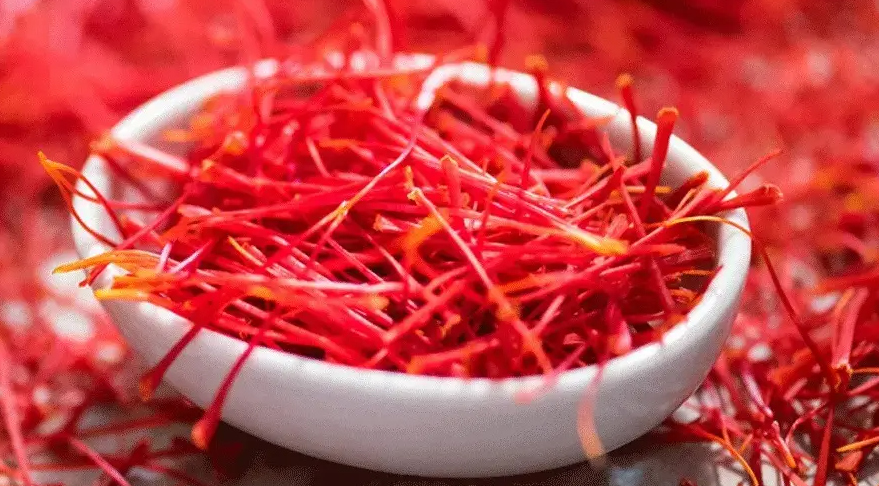
A thread is dried plant tissue, not a manufactured textile fibre. Natural differences in length, curve, width and colour are expected. The upper end is often broadened and trumpet-like. Dried stigmas may be curved, brittle and visibly plant-like. Identical, smooth, evenly cut fibres can be suspicious.
A red stigma may transition into orange or yellow lower down. A natural style portion is not automatically adulteration. Forms sometimes described as Pushal, Peyvand or Zarrin may retain such portions, although trade terminology varies.
A limited natural style portion is different from a product consisting mainly of yellow plant material but sold as high-quality red saffron. Saffrona’s LAAL, PAYWAND and ZARRIN pages explain our presentation names.
Documented forms of adulteration
- Dyed plant fibres: dried corn silk or other fibres can imitate saffron’s appearance. Morphology, microscopy, chemical profiles or DNA methods can help identify the source.
- Safflower substitution: Carthamus tinctorius, also known as safflower or “Golrang”, is a different plant. Its orange-red flower parts are not Crocus sativus saffron.
- Artificial imitations: literature describes coloured plant fibres, paper strips and even processed meat fibres made to resemble threads.
- Added weight: water, sugar, salt, oils or mineral material can increase selling weight. Moisture, ash and foreign-matter tests can reveal abnormalities.
- Powder dilution: turmeric, safflower, starch, dyes or other powders are harder to identify visually once material is ground.
- False origin: botanically genuine saffron can still carry an misleading geographic claim. Supply documents and specialised origin analysis help assess it.
What can home observations tell you?
| Observation | Possible clue | Does not prove |
|---|---|---|
| Natural, irregular stigma shape | Compatibility with plant tissue | Botanical identity without further examination |
| Golden colour release | Water-soluble colouring compounds | Authenticity, purity or geographic origin |
| Complex aroma and bitterness | A sensory profile compatible with saffron | Absence of added aroma or adulteration |
| Colour transfer when rubbed | Potential surface colouring | Fraud; natural pigments may also leave traces |
| Floating or sinking | Effects of moisture, structure or air bubbles | A reliable authenticity verdict |
| A yellow lower section | A natural style portion in some cuts | Either fraud or high quality automatically |
| A high price or luxury package | Positioning or production costs | Authenticity or an ISO category |
| A laboratory report | Results for the identified sample | Quality of every other batch |
Warm-water observation is not standardised. Dyed fibres may also release colour; speed alone proves little. Added aroma can imitate scent, while old genuine saffron may smell weak. Online floating and sinking rules are not reliable authentication methods.
How does a laboratory test saffron?
- Macro- and microscopy: examine morphology, tissue, pollen, foreign material and stigma features.
- ISO 3632 analysis: assesses colouring and related quality indicators, moisture, ash and foreign material using standardised methods.
- Chromatography and spectroscopy: HPLC, NMR, Raman, infrared or mass spectrometry can investigate compounds, dyes and unusual profiles.
- DNA methods: PCR, barcoding or sequencing can identify foreign botanical species and sometimes help quantify them.
These methods answer different questions. Standardised quality analysis is not always a complete origin or fraud investigation.
Traceability in the European market
A package from the producing country does not replace clear responsibility and traceability in the market where the food is sold. A label in a foreign language or the absence of an accessible batch report is a reason to ask questions, not proof of counterfeit saffron.
Under the EU food-information framework, responsibility rests with the operator under whose name the food is marketed or, if that operator is not established in the Union, the importer. Mandatory information includes the relevant operator’s name and address. Read the EU food-information rules.
Check the responsible business, batch or lot identification, net quantity, durability information and understandable product details. Trade restrictions can complicate cross-border business, but they are not a substitute for identifying the responsible seller or importer.
A traceable buying checklist
- Look for a clear food name or Crocus sativus identification.
- Choose whole threads if you want to inspect their original form.
- Check the responsible business or importer’s name and address.
- Review batch information, net quantity and relevant dates.
- Ask for the actual producing country, rather than only the packer’s address.
- Check whether a report identifies the batch, date, methods and laboratory.
- Distinguish ISO quality results from comprehensive authenticity or origin testing.
- Consider packaging and protection against light and moisture.
- Treat unsupported terms such as “A+++” or “world’s best” critically.
- For a complaint, keep the receipt, packaging, batch details and a sample where possible.
Scientific and regulatory background: saffron adulteration review, quality and authenticity methods, and the EU herbs and spices control action.
Sources and further scientific reading
The references throughout this guide connect specific topics to standards, research and institutional information. Research on extracts or isolated compounds should not be treated as evidence that culinary saffron has every proposed effect.
- ISO 3632-1:2025 · Specification
- ISO 3632-2:2010 · Test Methods
- Melnyk, Wang & Marcone · Chemical and Biological Properties of Saffron
- Crocus sativus · A Comprehensive Review
- Schmidt, Betti & Hensel · Saffron in Phytotherapy
- Christodoulou et al. · Potential Pharmaceutical Applications
- Biosynthesis of Picrocrocin in Crocus sativus
- Safranal · Chemistry, Pharmacology and Biological Activities
- Crocin and Crocetin · Biological Activities
- Saffron in Diabetes and Metabolic Syndrome · Review
- Saffron and Pregnancy · Cultural Practices and Safety Evidence
Explore this section
What is saffron? Learn about Crocus sativus, the harvested stigmas, its characteristic colour and aroma, culinary uses and the basics of choosing saffron.