
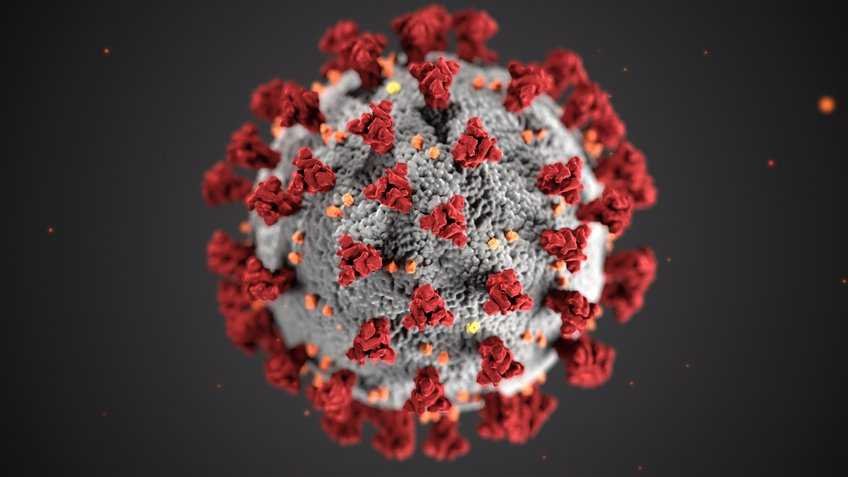
A 2025 molecular modelling study explored how saffron-related compounds might interact with the SARS-CoV-2 spike protein when combined with carbon nanotube carriers. This is computational research: it does not demonstrate that saffron prevents or treats COVID-19 in people.
Computer simulations and molecular docking · Experimental carrier systems · No clinical efficacy, safe dose or usable treatment established.
What the researchers investigated
Abedi, Rahmani and Mahnama examined saffron components with pristine and functionalised carbon nanotubes. Their workflow used molecular dynamics to model adsorption and encapsulation, followed by docking and simulations of interactions with the spike protein.
Findings inside the model
- Crocin and crocetin had the most promising docking scores: −39.5 and −32.1 kJ/mol respectively.
- Functionalised nanotube systems carrying these compounds showed strong modelled protein interactions.
- Structural analyses assessed changes in the complexes; most reached stability after about 200 nanoseconds of simulation.
- Functionalisation increased modelled hydrogen bonding.
These results identify candidates for further investigation under the model’s assumptions. They do not demonstrate antiviral activity in an infected person.
How to read a computational result
A docking score compares predicted molecular interactions. It is not a percentage reduction in illness, a clinical dose or a measurement of how well a substance works after it is eaten.
Similarly, a stable simulated complex does not prove that a carrier is safe, reaches the required tissue or improves a patient’s outcome. A nanotube delivery system is also very different from saffron threads used in food.
Further work would need to test the candidate experimentally, examine toxicity and delivery, and establish clinical safety and effectiveness before any treatment claim. Results should not be extended automatically to different virus variants.
Frequently asked questions
Does this show that saffron tea treats COVID-19?
No. The study models selected compounds and experimental carriers. It does not test saffron tea or culinary saffron as a treatment.
Can the docking scores be used to choose a dose?
No. A computational interaction score cannot be converted into a personal treatment dose.
Why publish this in a saffron academy?
It illustrates how researchers generate hypotheses around saffron compounds, and why the level of evidence matters when interpreting a promising headline.
Primary source
Abedi, K., Rahmani, Z. and Mahnama, M. (2025). Development of saffron-based inhibitor against COVID-19 spike protein: A molecular dynamics analysis. Next Research, 2(2), 100242. DOI: 10.1016/j.nexres.2025.100242.
Explore more research explanations in the Saffron Academy.